Voltar paraBack to FazendoTinkering
As palestras do Rory Sutherland, transcritas e organizadas.Rory Sutherland's talks, transcribed and organized.
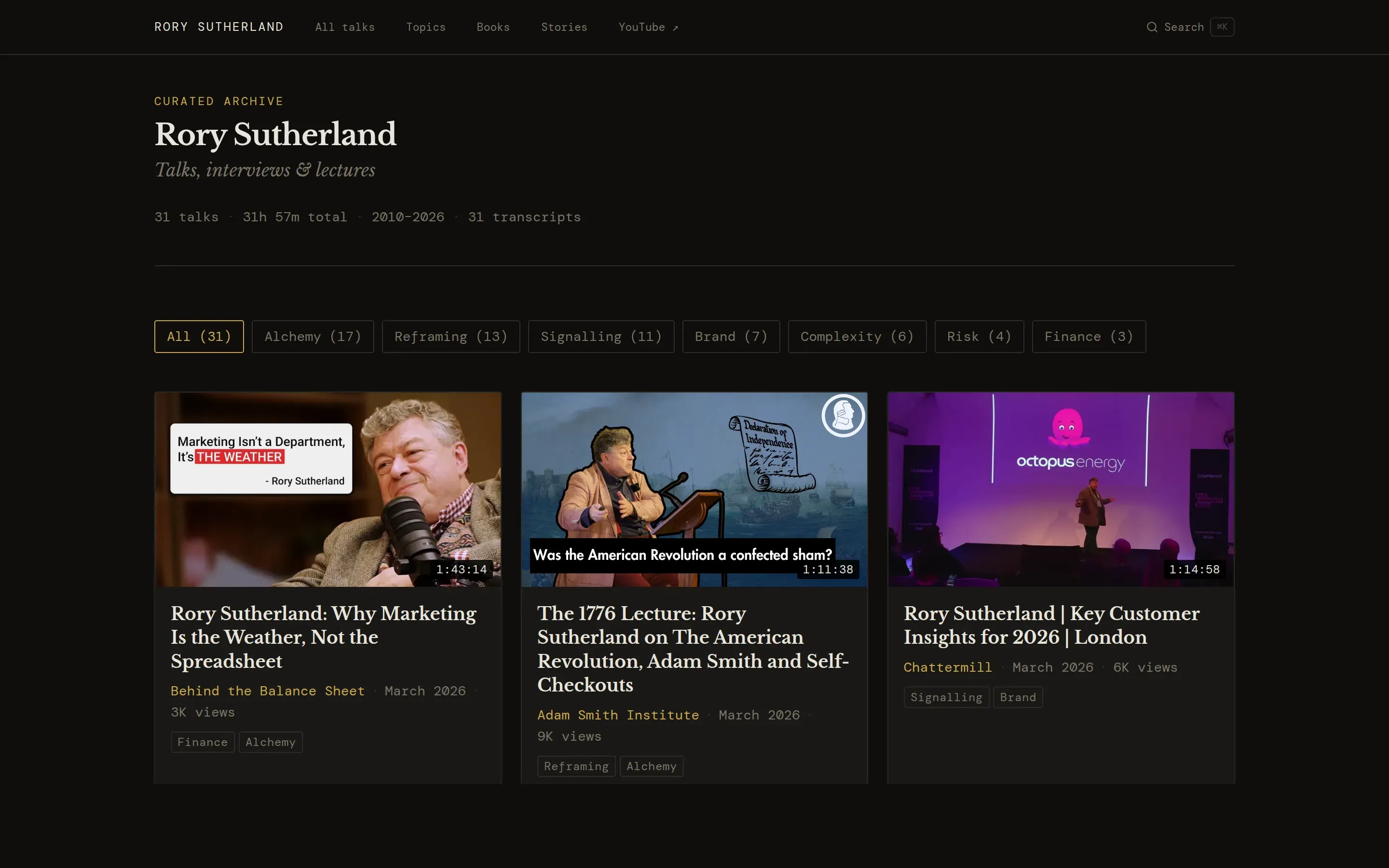
Um arquivo de fã com 31 palestras, entrevistas e aulas do Rory Sutherland, com transcrições, temas, livros e as histórias que ele repete.A fan archive of 31 Rory Sutherland talks, interviews and lectures, with transcripts, topics, books and the stories he keeps retelling.
ver no arsee it livecódigosource code
O incômodo
O Rory Sutherland é uma das pessoas que mais mudaram o jeito como eu penso marketing e comportamento, e eu gosto de ouvir ele, mesmo quando reconta uma história que eu já conheço. E ele reconta muito: as mesmas histórias voltam em palestras e entrevistas diferentes, cada vez de um jeito, espalhadas pelo YouTube em vídeos de uma hora ou mais. Eu queria um índice disso. Uma enciclopédia das histórias dele, que mostrasse onde ele contou cada uma e em que minuto.
O estalo
Vídeo não se pesquisa, texto sim. Com cada palestra transcrita em markdown puro, dá para buscar uma palavra em 32 horas de conteúdo, e dá para pedir ao Claude que leia tudo de uma vez e encontre padrões: quais histórias se repetem, que livros aparecem, que ideias atravessam as palestras.
O que fiz
Montei o site em Astro, com uma playlist no YouTube como fonte. Um script em Python usa o yt-dlp para baixar os metadados e as legendas de cada vídeo e salvar como transcrição. Em cima disso, o Claude gerou os principais pontos de cada palestra e indexou as histórias. O site oferece quatro formas de navegar:
E uma busca com ⌘K que procura nos títulos, nos pontos principais e no texto de todas as transcrições.
O resultado
- Palestras
- 31
- Horas
- 32
- Histórias
- 102
- Livros
- 17
Só uma parte das palestras teve as histórias catalogadas até agora. A mais repetida, por enquanto, é a do Eurostar: em vez de gastar bilhões para encurtar a viagem, pagar supermodelos para servir vinho de primeira a todos os passageiros, com uma fração do dinheiro. Ela aparece em quatro palestras.
O que aprendi
Design, código e dados foram a parte fácil. Difícil foi entender o conteúdo.
Montar o site, buscar as transcrições e organizar temas e livros andou rápido. Catalogar as histórias se provou muito mais difícil do que eu esperava. Para achar uma anedota, o Claude precisa ler a transcrição inteira, entender o contexto e reconhecer que é a mesma história contada de outro jeito em outra palestra. Isso custa muito token por palestra, e é por isso que o catálogo ainda está pela metade.
Ter o conteúdo em texto foi necessário, mas não suficiente. A parte cara não é guardar, é interpretar.
The itch
Rory Sutherland is one of the people who most changed how I think about marketing and behaviour, and I enjoy listening to him, even when he retells a story I already know. And he retells a lot: the same stories come back in different talks and interviews, a little different each time, scattered across YouTube in videos an hour long or more. I wanted an index of that. An encyclopedia of his stories, showing where he told each one and at what minute.
The insight
You can’t search video, but you can search text. With every talk transcribed into plain markdown, you can search for a word across 32 hours of content, and you can ask Claude to read all of it at once and find patterns: which stories repeat, which books come up, which ideas run through the talks.
What I did
I built the site with Astro, using a YouTube playlist as the source. A Python script uses yt-dlp to download each video’s metadata and subtitles and save them as a transcript. On top of that, Claude wrote the key takeaways for each talk and indexed the stories. The site offers four ways to browse:
Plus a ⌘K search across titles, takeaways and the text of every transcript.
The result
- Talks
- 31
- Hours
- 32
- Stories
- 102
- Books
- 17
Only some of the talks have had their stories cataloged so far. The most retold one, for now, is the Eurostar story: instead of spending billions to make the journey shorter, pay supermodels to serve vintage wine to every passenger, for a fraction of the money. It shows up in four talks.
What I learned
Design, code and data were the easy part. Understanding the content was the hard part.
Building the site, fetching the transcripts and organizing topics and books went fast. Cataloging the stories turned out to be much harder than I expected. To find an anecdote, Claude has to read the whole transcript, understand the context and recognize that it’s the same story told differently in another talk. That costs a lot of tokens per talk, which is why the catalog is still half done.
Having the content as text was necessary, but not enough. The expensive part isn’t storing it, it’s interpreting it.